Showing posts with label Picturebook. Show all posts

Tuesday, November 29, 2016

If You Take a Mouse to School

Numeroff, Laura. If You Take a Mouse to School. (2002). Bond, Felicia (Illus.). New York, New York: HarperCollins

Image result for if you take a mouse to school summaryYou never know what the mouse is going to ask for next when you decide to take him to school. The illustrations help you guess what is going to happen next, but sometimes you never know what the mouse is actually going to want.

Connecting to the Standards
Grade 2 RL (4): Describe how words and phrases (e.g., regular beats, alliteration, rhymes, repeated lines) supply rhythm and meaning in a story, poem or song.
  • Students will meet this standard through the active participation in the read aloud. As the students catch on the the repeated sentences, the teacher will invite the students to read along. 
Grade 2 RL (7): Use information gained from the illustrations and words in a print or digital text to demonstrate understanding of its characters, setting, or plot.
  • Students will meet this standard because before we flip pages, students will be given the chance to make an inference as to what is coming next in the text.

Learning Outcomes  
Students will be able to finish the sentences "If you take a mouse to school, he'll ask you for your _______. When you give him your ______ he'll want a ______ to go with it, by following the same pattern set up in the text. Student will also draw a picture of their sentence.

Adapted to the Classroom 
When reading this book you would read in a manner that students would be able to catch up on the pattern and be able to eventually guess what is going to come next.

While reading students will actively  participate in the read allowed. Students will be given a chance to guess what is coming next. After reading students will create their own explain following the same pattern from the text.

Bloom's Taxonomy 
List three request that the mouse had. (Knowledge)
How would you use the pattern in the story to develop another page to the story. (Application)

Differentiation 
For students with a hearing impairments the teacher will be wearing a microphone and the student will be wearing the receiver so that the sound is amplified and they can hear what the students are saying.
For students with visual impairments the teacher would use a large print book so that the studnet can follow along with the teacher.

Monday, November 28, 2016

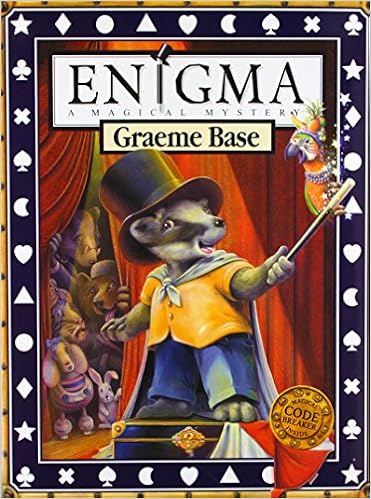
Enigma - A Magical Mystery

Base, Graeme. Enigma- A Magical Mystery. (2008). Base, Graeme (Illus.). New York, New York Abrams Books for Young Readers

Image result for enigma a magical mystery publication dateBertie was expecting a typical visit to see his grandfather at his retirement home. But much to Bertie's surprise it was not a typical visit. Bertie spend his time trying to find his grandfather's rabbit Enigma, and helping the other residents of the retirement home get their magic back.

Connecting to the Standards
Grade 2 RL (2): Ask and answer such questions as who, what, where, when, why, and how to demonstrate understanding of key details in a text.
  • Students will demonstrate this when we are discussing the different character and what their magic power is. 
Grade 2 RL (7): Use information gained from the illustrations and words in a print or digital text to demonstrate understanding of its characters, setting, or plot.
  • Students will meet this standard when they make predictions about what magic power each character has prior to finding out what magic power they actually have.

Learning Outcomes 
Given the question "If you could have any magic powers, what would they be and why?," students will formulate an answer with 80% accuracy.

Adapted to the Classroom
This would be a read a loud used when discussing sequence and patterns due to the code that has to be broken in the back to display. While reading students would make predictions as to what the different characters magical powers are before we read.When we are finished reading we will make a chart listing the character and their magic power. After we are done reading we will work toward trying to solve the code in the back of the book.

After discussing the code, we would go back and discuss the events that happened in the text. While discussing we would touch on Magic and discuss Magicians. While discussing Magicians and what they do we would discuss magic. After discussing I would students the chance to answer the question "If you could have any magic powers, what would they be and why?" After students had a chance to answer this question they would report back to class, so the class could hear about what magic power they would want to have.

Bloom's Taxonomy 
What is a Magician? (Knowledge)
What approach would you use to solve the mystery in the retirement home? (Application)

Differentiation
For students with Dyslexia, they would be aloud to use the dictionary to look up words they are not sure how to spell in order to answer the questions about which magic power they would want
For students who finish early, they would be given worksheets where they are trying to crack the code.

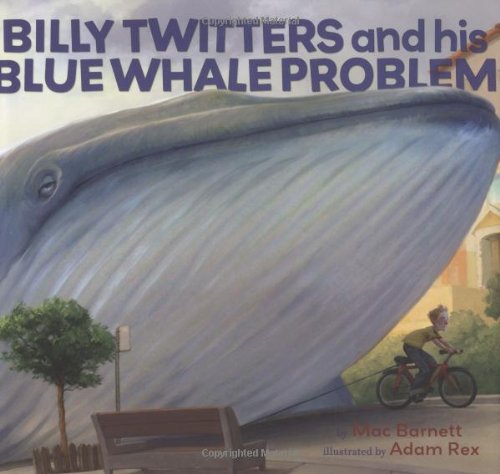
Billy Twitters and his Blue Whale Problem

Barnett, Mack. Billy Twitters and his Blue Whale Problem (2009). Rex, Adam (Illus.). New York, New York, Disney-Hyperion

Image result for billy twitters and the blue whale problem publisherBilly never believed his parents when they would say "Billy you need to do this or we will buy you a blue whale." Until one day his parents actually bought him a whale. After this Billy is forced to take care of the whale, and begins that having a whale for a pet is not as fun as it sounds.

Connecting to the Standards
Grade 2 L (2): Demonstrate command of the conventions of standard English capitalization, punctuation, and spelling when writing. B: Use commas in greetings and closing of letters
  •  Students will meet this standard by writing a letter asking for a whale using the correct letter format.
Grade 2 L (3): Use knowledge of language and its conventions when writing, speaking, reading, or listening
  • Students will meet this standard by writing a letter asking for a whale, in their letters they will have to use the English language correctly to make sure they ask for their whale correctly.
Learning Outcomes 
After discussing the components of a letter, students will write a letter requesting a whale with 80% accuracy.

Adapted to the Classroom 
During our pre-reading this text, students will be given a chance to physically look at this book. While students are looking this text will be giving the chance to find the spot where is says they can send for a whale. Prior to reading we will also do some research about whales and learn about whales.

While reading the text, we will use some during reading skills. We will make connections to information we already know about whales and new learning. While reading we will also go over new vocabulary words that come up

After reading, I will ask students if they found anything interesting in the book. Through the use of scaffolding I will lead them to get to the point about sending for a whale. After they discover this, we will discuss letters, how to write them, and what a letter is. It is at this point I will give students a chance to draft a letter asking for a whale. Once we have received our whales we will write letters to our whales each month and students will be given a chance to call their whale as well.

Bloom's Taxonomy 
Suppose you were in Billy's shoes, how would you have reacted to receiving a whale? (Synthesis)
What would have resulted if Billy would have listen to his parents in the beginning? (Application)

Differentiation
For students with Dyslexia, they will be able to use technology to help them write their letters asking for a whale.  
For students who are finished early, they will be given the chance to do a work sheet with questions about whales on it.

And Tango Makes Three

Parnell, Peter and Richardson, Justin. And Tango Makes Three. (2005). Cole, Henry (Illus.). New York, New York: Simon & Schuster

Image result for and three makes tangoIn the Central Park Zoo, there are two male penguins who only dream of having an egg to raise. They try everything they can to get an egg to raise but are no successful. After much waiting they finally got their egg, and were able to be parents. Throughout the text you see the two grow penguins grow into amazing parents.

Connecting to the Standards
Grade 2 W (5): With guidance and support from adults and peers, focus on a topic and strengthen writing as needed by revising and editing.
  • Students will meet this standard when they work on their paragraphs about their family and go through the writing process to get their final product. 
Grade 2 L (2): Demonstrate command of the conventions of standard English capitalization, punctuation, and spelling when writing. A: Capitalize holidays, product names, and geographic names. E: Consult reference materials, including beginning dictionaries, as needed to check and correct spellings.
  • Students will meet this goal when work through writing process. After creating the rough draft they will have to go through and revise, making sure they have spelled unknown workds correctly and that they use proper capitalization in their paper.

Learning Outcomes
Students will create a paper about their family by working through the writing process with 80% accuracy.

Adapted to the Classroom
This would be used in the classroom when discussing the topic of families. When talking about families we would talk about the different traditions each family has and who makes up your family.  After reading this text students would work through the writing process to write a paper on their family. For the final draft students would be allowed to either type their paper on the computer or hand write it if they would like. After they finished writing their paper they would draw a picture of their family to go along with their paper. After students have finished their paper students would be given a chance to stand up in front of the class and read their paper. While the student is reading their paper, their picture of their family would be displayed on the board so that all students could see the visual representation of what the students family look like.

Bloom's Taxonomy 
How many members do you have in your family? (Knowledge) 
Identify one tradition that your family has. (Application)
Elaborate on what your favorite memory is with your family. (Synthesis)

Differentiation 
For students who are ELL, they would be given the option to incorporate some of their native language into their paragraphs and presentation.
For students with Dyslexia they will be allowed to use a dictionary to make sure they are spelling the words correctly.
For students who visual learners they will be given the chance to draw their family members for people to see.

So You Want to be President

St. George, Judith. So You Want to be President (2000). Small, David (Illus.). New York, New York: Philomel Books

Image result for so you want to be presidentIn this text you learn all the positives and all the negatives that come with being President of the United States. While learning about the positives and the negatives, you also learn a little about each President. Not only do you learn fun facts about each President but you also learn fun facts about all the Presidents, like how many were born in long cabins and how many have the same name.

Connecting to Standards
Grade 2 W (7): Participate in shared research and writing projects (e.g. read a number of books on a single topic to produce a report; record science observations)
  • This content standard is met by the students getting into groups and doing research on the description of the president and having to report back to the class 
Grade 2 W (2): Write informative/ explanatory texts in which they introduce a topic, use facts and definitions to develop points, and provide a concluding statement or section.
  • This content standard is met by the students having to write paragraphs about one President of their choice. These paragraphs will be comprised on the information they found when doing research on the President of their choice
Learning Outcomes
After reading this text, students will pick a President to research and will write a paragraph biography about said President with 80% accuracy.

Adapted to Classroom
Prior to reading this text we would discuss the different Presidents of the United States. While discussing the Presidents we would make a time line so that students can visually see when the Presidents where President. While we are making a timeline we would discuss each President, whether that be by watching a video, reading a book, or doing some class research together on said President. During this discussion we would do some class research about the job's the President has, requirements to be President, and just overall important information regarding the President. This research would be done by having students break into groups and pick different categories of information to research on the President

After priming the students with all the information we would read this text. While reading this text we would start by taking a tally of how many students say "yes" or say "no" for wanting to be president. While we are reading the text we would make connections to the research that the students did.

After the read aloud is finished we would retake our poll and see who still wants to be president and who does not want to be President. After taking this poll we would discuss what we read in the text. While discussing this would be when I introduce the project to the children. For the project each student would research one particular President. They would answer research questions and would write a paragraph about the President they picked. These paragraphs would then be hung in the hall with a picture the student picked. 

Bloom's Taxonomy 
What is the name of the house the President lives in? (Knowledge)
In your opinion what is the best thing about the President you researched? (Evaluation) 

Differentiation
One way to differentiated this lesson is by allowing students to work in partners. This will allow students who are ELL or with SPED services to receive extra help from their classmate.
For students who are gifted you can require extra questions for them to answer forcing them to go in depth with research. 

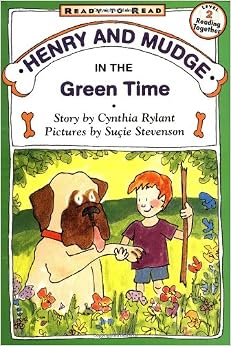
Henry and Mudge: In the Green Time

Rylant, Cynthia. Henry and Mudge In The Green Time. (1987). Stevenson Sucie (Illus.).
     New York, New York: Bradbury Press

Image result for henry and mudge in the green time summaryThis adventure of Henry and Mudge takes place in the summer and all the things they can do on green grass. They have a picnic on the grass in the park where Henry gets stung by a bee but Mudge cheers him up. They play with the water hose out on the green lawn to give Mudge a bath that he does not like, so he gets Henry back soaking him when he shakes all the water off. Finally Henry and Mudge head up a hill where they let there magic imaginations unleash and eventually get worn out and fall asleep under the tree.

Connecting to the Standards
Grade 2 RL (1): Ask and answer such questions as who, what, where, when, why, and how to demonstrate understanding of key details in text
  • This story allows student to answer a questions about what Henry and Mudge
     do when they are in the 3 different chapter. 
Grade 2 W (3): Write narratives in which they recount a well-elaborated event or short sequence of events, include details to describe actions, thoughts, and feelings, use temporal words to signal event order and provide a sense of closure
  • This story allows students to meet this standard because they can write about the different events in each of the 3 different chapters.

Learning Outcomes
Students will answer the question, "Which Henry and Mudge story was your favorite and why, and who is your favorite character and why?" citing the text twice with 80% accuracy

Adapted to the Classroom 
After reading the text as a class we would discuss what happened in each story. While discussing we would write down a class summary of each text and events we think to be important. It is at this point that I would ask questions to help the children. Through this discussion I would make sure that each students have a good understanding as to what happened in each story. Once student's understanding have been checked, I would then dismiss students to answer the overall question. It is at this time that students would answer the question "Which Henry and Mudge story was your favorite and why?" and "Who is your favorite character and why?"

Once students have completed this text as a class we would then create a graph to see which story was the class favorite and which character was the class favorite.

Bloom's Taxonomy
Who are the main characters in our story? (Knowledge)
 If you were Mudge, how would you solve the problem of not wanted to take a bath? (Application)
Suppose you could have a magical place like Henry and Mudge, what would do when you are at your magical place? (Synthesis)

Differentiation 
For students who are not able to write, we would make sure that they have access to assistive technology that would allow them to type out their answer to the questions.
For students who are gifted we would take the questions one step further to make sure that they are stilling being challenged

The Wizard

Image result for the wizard jack prelutskyPrelutsky, Jack. (2007). The Wizard. B. Dorman (Illus.). New York, New York: Greenwillow Books

This adaptation of a poem from Nightmares: Poems to Trouble Your Sleep shows the life of a wizard living in a tower. Bored by the monotony of his daily life, he decides to have fun when a bullfrog shows up, turning him into everything from a cockatoo to a flash of light.

Connecting to the Standards
Grade 2 RL (4): Describe how words and phrases (e.g., regular beats, alliteration, rhymes, repeated lines) supply rhythm and meaning in a story, poem, or song.
  • Students will be able to recognize and identify the rhyme and beat of this poem.
Grade 2 SL (5): Create audio recordings of stories or poems; add drawings or other visual displays to stories or recounts of experiences when appropriate to clarify ideas, thoughts, and feelings.
  • Students will write and perform their own poem that has rhyme and rhyme.
Learning Outcomes
Students will be able to identify rhythm and rhyme in a story. They will identify the ending words that create the rhyme and the meter that creates the rhythm. Students will be able to write, edit, and revise their own poetry using meter and rhyme, much like The Wizard. 

Adapted to the Classroom
Students should have already had some experience with poetry and identifying rhythm and rhyme before they are asked to complete the creative writing activity in this lesson, writing there own poem with rhythm and rhyme. 

The book in this lesson, The Wizard is just one example of a poem book that can be used along with this creative writing activity. Students should be exposed to a variety of rhythm-and-rhyme poetry to establish an understanding of different types of rhythm and possibilities for rhyme. 

Once this understanding has been established, students will engage in a creative writing activity that tests their understanding of rhythm-and-rhyme poetry. Students will, over a long writing period, create their own poem using rhythm and rhyme. Students will write over a period of 2-3 weeks, editing and revising their poems. When they are finished, the poems could be recorded by the students and posted to the classroom website.

Bloom's Taxonomy
What are the parts or features of a rhythm-and-rhyme poem? (Analysis)
Create your own rhythm-and-rhyme poem. (Synthesis)

Differentiation
Because this assignment occurs over a long period of time, teachers will have the chance to meet with students who are having trouble completing the assignment and help them get back on track. Some possibilities for support may include a rhyming dictionary or give students the chance to look online for rhymes for their poems. 

Saturday, November 26, 2016

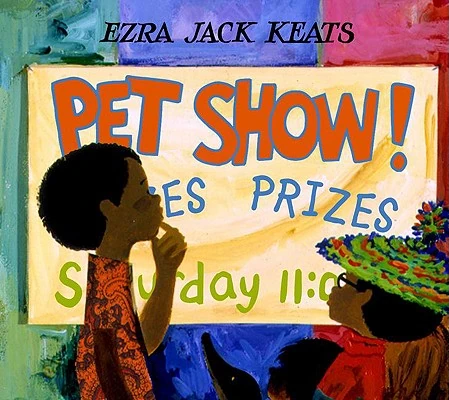
Pet Show!

Image result for pet show ezra jack keatsKeats, Ezra Jack. (1972). Pet Show. New York, New York: Viking Penguin. (Picturebook).

It's time for the Pet Show and Archie is eager to try to win an award. But his pet, his cat, is missing! Archie's quick-thinking still gives him the chance to win an award and he finds his cat in the process.

Connecting to the Standards
Kindergarten L (5a,b): With guidance and support from adults, explore word relationships and nuances in word meanings. a. Sort common objects into categories (e.g., shapes, foods) to gain a sense of the concepts the categories represent. b. Demonstrate understanding of frequently occurring verbs and adjectives by relating them to their opposites (antonyms).

  • The book has a variety of words that can be organized into groups including animals and adjectives.

Kindergarten RL (3): With prompting and support, identify characters, settings, and major events in a story.

  • There are multiple recognizable characters in the story, from the main character, Archie, to the supporting characters, Roberto, Peter, and Susie. 

Kindergarten RL (7): With prompting and support, describe the relationship between illustrations and the story in which they appear (e.g., what moment in a story an illustration depicts).

  • In the illustrations, you can see clear connections to the text. The clearest connection is during the sequence, "Willie chased the mouse. Roberto chased Willie. Peter chased Roberto. Susie chased Peter." The illustration clearly shows this sequence in a linear fashion.
Learning Outcomes
Through this book, students will be able to sort words into categories including animals and adjectives. During the pet show, a diversity of pets and adjectives to describe the pets are used in the text. Students should be able to take a list of these words mixed up and organize them in small groups into their respective categories. They will create a graph that shows the different words in their categories which will be collected as data.

Adapted to the Classroom
I would start by establishing some prior schema about sorting before reading the book. Students would sort familiar categories such as fruits, numbers, letters, etc. Then I would do a full classroom read-aloud, guided by the teacher. This would help to establish the story with the classroom before they begin to work in groups/independently. 

Once students are familiar with the story, they can begin to work in small groups, sorting the words found in the books into a graph. On one side would be animals, the other side adjectives. Here is the word list:
Animals: ant, mouse, cat, parrot, frog, fish, canary, goldfish, dog, puppy, turtle
Description: noisy, handsome, friendly, yellow, busy, bright, long, fast, soft, slow

The final activity would to have students bring in their stuffed animals (or have the teacher provide them because of lice and bed bugs) or have students have their very own pet show. They could use the adjectives or new one's they've come up with to give every pet their own blue ribbon. This may be difficult because not every student may have a pet. Another idea would be to introduce one or two classroom pets and have the children decide on an award for the pets. 

Bloom's Taxonomy
Who is the main character of this story? (Knowledge)
Classify a list of words according to the category. (Analysis)
Create your own blue ribbon awards using descriptive words/adjectives for ___________. (Sythesis)

Differentiation
Most of these activities should be doable for most students. If there is any cutting for the graph students are to make, the teacher should probably do it as there are a lot of words to be cut out. Because animals are an interest among many young children, this book and the accompanying activities should hold most students interest. Activities will be limited to a short time and may even be spread over a few days to make sure interest doesn't wane and children are actively involved.