Showing posts with label Magic. Show all posts

Monday, November 28, 2016

Enigma - A Magical Mystery

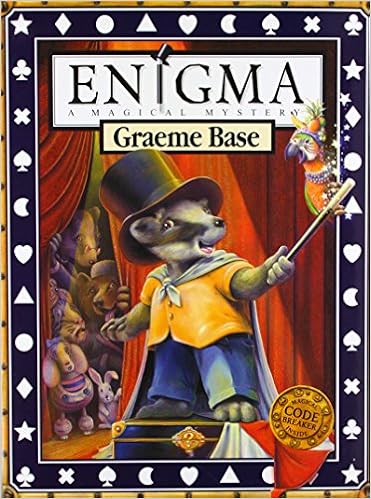
Base, Graeme. Enigma- A Magical Mystery. (2008). Base, Graeme (Illus.). New York, New York Abrams Books for Young Readers

Image result for enigma a magical mystery publication dateBertie was expecting a typical visit to see his grandfather at his retirement home. But much to Bertie's surprise it was not a typical visit. Bertie spend his time trying to find his grandfather's rabbit Enigma, and helping the other residents of the retirement home get their magic back.

Connecting to the Standards
Grade 2 RL (2): Ask and answer such questions as who, what, where, when, why, and how to demonstrate understanding of key details in a text.
  • Students will demonstrate this when we are discussing the different character and what their magic power is. 
Grade 2 RL (7): Use information gained from the illustrations and words in a print or digital text to demonstrate understanding of its characters, setting, or plot.
  • Students will meet this standard when they make predictions about what magic power each character has prior to finding out what magic power they actually have.

Learning Outcomes 
Given the question "If you could have any magic powers, what would they be and why?," students will formulate an answer with 80% accuracy.

Adapted to the Classroom
This would be a read a loud used when discussing sequence and patterns due to the code that has to be broken in the back to display. While reading students would make predictions as to what the different characters magical powers are before we read.When we are finished reading we will make a chart listing the character and their magic power. After we are done reading we will work toward trying to solve the code in the back of the book.

After discussing the code, we would go back and discuss the events that happened in the text. While discussing we would touch on Magic and discuss Magicians. While discussing Magicians and what they do we would discuss magic. After discussing I would students the chance to answer the question "If you could have any magic powers, what would they be and why?" After students had a chance to answer this question they would report back to class, so the class could hear about what magic power they would want to have.

Bloom's Taxonomy 
What is a Magician? (Knowledge)
What approach would you use to solve the mystery in the retirement home? (Application)

Differentiation
For students with Dyslexia, they would be aloud to use the dictionary to look up words they are not sure how to spell in order to answer the questions about which magic power they would want
For students who finish early, they would be given worksheets where they are trying to crack the code.

The Wizard

Image result for the wizard jack prelutskyPrelutsky, Jack. (2007). The Wizard. B. Dorman (Illus.). New York, New York: Greenwillow Books

This adaptation of a poem from Nightmares: Poems to Trouble Your Sleep shows the life of a wizard living in a tower. Bored by the monotony of his daily life, he decides to have fun when a bullfrog shows up, turning him into everything from a cockatoo to a flash of light.

Connecting to the Standards
Grade 2 RL (4): Describe how words and phrases (e.g., regular beats, alliteration, rhymes, repeated lines) supply rhythm and meaning in a story, poem, or song.
  • Students will be able to recognize and identify the rhyme and beat of this poem.
Grade 2 SL (5): Create audio recordings of stories or poems; add drawings or other visual displays to stories or recounts of experiences when appropriate to clarify ideas, thoughts, and feelings.
  • Students will write and perform their own poem that has rhyme and rhyme.
Learning Outcomes
Students will be able to identify rhythm and rhyme in a story. They will identify the ending words that create the rhyme and the meter that creates the rhythm. Students will be able to write, edit, and revise their own poetry using meter and rhyme, much like The Wizard

Adapted to the Classroom
Students should have already had some experience with poetry and identifying rhythm and rhyme before they are asked to complete the creative writing activity in this lesson, writing there own poem with rhythm and rhyme. 

The book in this lesson, The Wizard is just one example of a poem book that can be used along with this creative writing activity. Students should be exposed to a variety of rhythm-and-rhyme poetry to establish an understanding of different types of rhythm and possibilities for rhyme. 

Once this understanding has been established, students will engage in a creative writing activity that tests their understanding of rhythm-and-rhyme poetry. Students will, over a long writing period, create their own poem using rhythm and rhyme. Students will write over a period of 2-3 weeks, editing and revising their poems. When they are finished, the poems could be recorded by the students and posted to the classroom website.

Bloom's Taxonomy
What are the parts or features of a rhythm-and-rhyme poem? (Analysis)
Create your own rhythm-and-rhyme poem. (Synthesis)

Differentiation
Because this assignment occurs over a long period of time, teachers will have the chance to meet with students who are having trouble completing the assignment and help them get back on track. Some possibilities for support may include a rhyming dictionary or give students the chance to look online for rhymes for their poems.