Showing posts with label Sharing. Show all posts

Monday, November 28, 2016

And Tango Makes Three

Parnell, Peter and Richardson, Justin. And Tango Makes Three. (2005). Cole, Henry (Illus.). New York, New York: Simon & Schuster

Image result for and three makes tangoIn the Central Park Zoo, there are two male penguins who only dream of having an egg to raise. They try everything they can to get an egg to raise but are no successful. After much waiting they finally got their egg, and were able to be parents. Throughout the text you see the two grow penguins grow into amazing parents.

Connecting to the Standards
Grade 2 W (5): With guidance and support from adults and peers, focus on a topic and strengthen writing as needed by revising and editing.
  • Students will meet this standard when they work on their paragraphs about their family and go through the writing process to get their final product. 
Grade 2 L (2): Demonstrate command of the conventions of standard English capitalization, punctuation, and spelling when writing. A: Capitalize holidays, product names, and geographic names. E: Consult reference materials, including beginning dictionaries, as needed to check and correct spellings.
  • Students will meet this goal when work through writing process. After creating the rough draft they will have to go through and revise, making sure they have spelled unknown workds correctly and that they use proper capitalization in their paper.

Learning Outcomes
Students will create a paper about their family by working through the writing process with 80% accuracy.

Adapted to the Classroom
This would be used in the classroom when discussing the topic of families. When talking about families we would talk about the different traditions each family has and who makes up your family.  After reading this text students would work through the writing process to write a paper on their family. For the final draft students would be allowed to either type their paper on the computer or hand write it if they would like. After they finished writing their paper they would draw a picture of their family to go along with their paper. After students have finished their paper students would be given a chance to stand up in front of the class and read their paper. While the student is reading their paper, their picture of their family would be displayed on the board so that all students could see the visual representation of what the students family look like.

Bloom's Taxonomy 
How many members do you have in your family? (Knowledge) 
Identify one tradition that your family has. (Application)
Elaborate on what your favorite memory is with your family. (Synthesis)

Differentiation 
For students who are ELL, they would be given the option to incorporate some of their native language into their paragraphs and presentation.
For students with Dyslexia they will be allowed to use a dictionary to make sure they are spelling the words correctly.
For students who visual learners they will be given the chance to draw their family members for people to see.

Saturday, November 26, 2016

Pet Show!

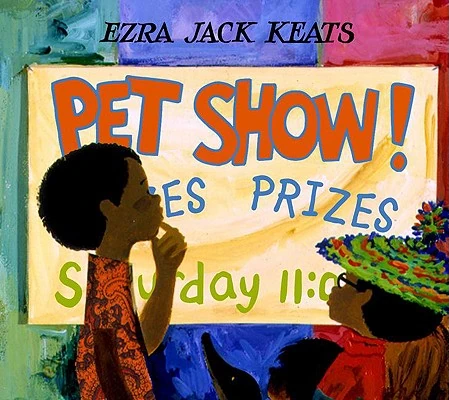
Image result for pet show ezra jack keatsKeats, Ezra Jack. (1972). Pet Show. New York, New York: Viking Penguin. (Picturebook).

It's time for the Pet Show and Archie is eager to try to win an award. But his pet, his cat, is missing! Archie's quick-thinking still gives him the chance to win an award and he finds his cat in the process.

Connecting to the Standards
Kindergarten L (5a,b): With guidance and support from adults, explore word relationships and nuances in word meanings. a. Sort common objects into categories (e.g., shapes, foods) to gain a sense of the concepts the categories represent. b. Demonstrate understanding of frequently occurring verbs and adjectives by relating them to their opposites (antonyms).

  • The book has a variety of words that can be organized into groups including animals and adjectives.

Kindergarten RL (3): With prompting and support, identify characters, settings, and major events in a story.

  • There are multiple recognizable characters in the story, from the main character, Archie, to the supporting characters, Roberto, Peter, and Susie. 

Kindergarten RL (7): With prompting and support, describe the relationship between illustrations and the story in which they appear (e.g., what moment in a story an illustration depicts).

  • In the illustrations, you can see clear connections to the text. The clearest connection is during the sequence, "Willie chased the mouse. Roberto chased Willie. Peter chased Roberto. Susie chased Peter." The illustration clearly shows this sequence in a linear fashion.
Learning Outcomes
Through this book, students will be able to sort words into categories including animals and adjectives. During the pet show, a diversity of pets and adjectives to describe the pets are used in the text. Students should be able to take a list of these words mixed up and organize them in small groups into their respective categories. They will create a graph that shows the different words in their categories which will be collected as data.

Adapted to the Classroom
I would start by establishing some prior schema about sorting before reading the book. Students would sort familiar categories such as fruits, numbers, letters, etc. Then I would do a full classroom read-aloud, guided by the teacher. This would help to establish the story with the classroom before they begin to work in groups/independently. 

Once students are familiar with the story, they can begin to work in small groups, sorting the words found in the books into a graph. On one side would be animals, the other side adjectives. Here is the word list:
Animals: ant, mouse, cat, parrot, frog, fish, canary, goldfish, dog, puppy, turtle
Description: noisy, handsome, friendly, yellow, busy, bright, long, fast, soft, slow

The final activity would to have students bring in their stuffed animals (or have the teacher provide them because of lice and bed bugs) or have students have their very own pet show. They could use the adjectives or new one's they've come up with to give every pet their own blue ribbon. This may be difficult because not every student may have a pet. Another idea would be to introduce one or two classroom pets and have the children decide on an award for the pets. 

Bloom's Taxonomy
Who is the main character of this story? (Knowledge)
Classify a list of words according to the category. (Analysis)
Create your own blue ribbon awards using descriptive words/adjectives for ___________. (Sythesis)

Differentiation
Most of these activities should be doable for most students. If there is any cutting for the graph students are to make, the teacher should probably do it as there are a lot of words to be cut out. Because animals are an interest among many young children, this book and the accompanying activities should hold most students interest. Activities will be limited to a short time and may even be spread over a few days to make sure interest doesn't wane and children are actively involved.