Showing posts with label Grade 2. Show all posts

Tuesday, November 29, 2016

The Relatives Came

Rylant, Cynthia. The Relatives Came. (1993). Gammell, Stephen (Illus.).   Atheneum Books for Young Readers

Image result for the relatives cameWho does not love leaving at 4:00am to drive to spend weeks on end with your relatives. Through this text you will see how daily life changes when the relatives come to town. You will also see traditions that only happen when the relatives come to visit.

Connecting to the Standards

Grade 2 SL (4): Tell a story or recount an experience with appropriate facts and relevant, descriptive details, speaking audibly in coherent sentences.
  • Students will meet this standard when they are given the change to present to the class about their family tradition. 
 
Learning Outcomes  
Students will write about a tradition that they have with their family with 80% accuracy.

Adapted to the Classroom  
To start this less you can your students if they know what a relative is, and what traditions the students have when relatives come to visit. If the students do not know what a relative is, you will give them context clues to help them get to the point where they can figure it out on their own. After you have established what a relative is with the students you will read this text. While reading the text you will use reading strategies to make sure the students are still engaged into the story. After the story is over, talk with the class about family traditions that happened within the text. When this conversation has closed, you will give students the chance to write about one of their traditions. When they finish writing about their traditions, students will be given the chance to tell the class about their tradition they have with their family.

Bloom's Taxonomy

What is a relative? (Knowledge)
Identify three traditions your family has. (Application)


Differentiation 
For students with Dyslexia, they will be given the option to either type their response or they will be provided with a dictionary to help with spelling if they choose to hand write it
For students who finish their assignment early, they will be ask to draw a picture of what their tradition looks like.

Catfish Tale

Stewart, Whitney. Catfish Tale. (2014). Guerlla's, Gerald (Illus.). Park Ridge Illinois: Albert Whitman & Company

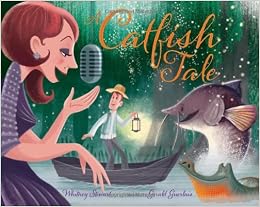
Image result for Catfish TaleHave you every heard of a Catfish with magical powers down in they Bayou? Well Jack has and when he tells his wife everything changes. She makes bigger and bigger wishes, until she just simply wishes she could go back to the way things were. 

Connecting to the Standards 
 Grade 2 RI (4): Determine the meaning of words and phrases in a text relevant to a grade 2 topic or subject area
  • Students will meet this standard when they are learning vocabulary words. When you go over the vocabulary words, not all the vocabulary words will be gone over so that when you get to them in the text you can ask the students and they can use context to figure it out 
Grade 2 RI (9): Compare and contrast the most important points presented by two texts on the same topic
  • Students will meet this standard by creating their chart to see if each fair tale meets their component of a fairy tale they are looking for. 

Learning Outcomes
In groups of two or three, students will be in charge of finding one component of a fairy tale in each of the fairy tales read throughout the lesson. Students will be in charge of charting whether the component is there or not. 

Adapted to the Classroom 
This text would be used when you are studying about fairy tales. Before reading this students would know what a fair tales is and all the components of a fairy tale. In the fairy tale unit you would be working on finding all the components of a fairy tale, in text that are believed to be fairy tales. Students would be in groups of two or three and would be looking for a certain component for each fairy tale read. Students would be given a chart with their component and all the fair tales read, the the story is being read they would check the box to see if the component had been met or would leave it blank if it had not. At the end of the unit, we would create a big chart with all the components and the stories read. Students would then be invited to mark the stories that met their component.

For this text in particular before reading you would introduce new vocabulary. There are so many knew vocabulary to students because of the setting of the story, that this is a major learning opportunity for students.

Bloom's Taxonomy 
What is a Bayou and where is it located? (Knowledge)
Why do you think that Jolie made the wishes she did? (Analysis)
How would you use a wish from a magical Catfish if you found one? (Application)

Differentiation
For ELL students, directions on what the task is would be given in both English and their native language.
For gifted students, they will have to make a graph at the end showing how many books where fairy tales and how many books where not fairy tales

If You Take a Mouse to School

Numeroff, Laura. If You Take a Mouse to School. (2002). Bond, Felicia (Illus.). New York, New York: HarperCollins

Image result for if you take a mouse to school summaryYou never know what the mouse is going to ask for next when you decide to take him to school. The illustrations help you guess what is going to happen next, but sometimes you never know what the mouse is actually going to want.

Connecting to the Standards
Grade 2 RL (4): Describe how words and phrases (e.g., regular beats, alliteration, rhymes, repeated lines) supply rhythm and meaning in a story, poem or song.
  • Students will meet this standard through the active participation in the read aloud. As the students catch on the the repeated sentences, the teacher will invite the students to read along. 
Grade 2 RL (7): Use information gained from the illustrations and words in a print or digital text to demonstrate understanding of its characters, setting, or plot.
  • Students will meet this standard because before we flip pages, students will be given the chance to make an inference as to what is coming next in the text.

Learning Outcomes  
Students will be able to finish the sentences "If you take a mouse to school, he'll ask you for your _______. When you give him your ______ he'll want a ______ to go with it, by following the same pattern set up in the text. Student will also draw a picture of their sentence.

Adapted to the Classroom 
When reading this book you would read in a manner that students would be able to catch up on the pattern and be able to eventually guess what is going to come next.

While reading students will actively  participate in the read allowed. Students will be given a chance to guess what is coming next. After reading students will create their own explain following the same pattern from the text.

Bloom's Taxonomy 
List three request that the mouse had. (Knowledge)
How would you use the pattern in the story to develop another page to the story. (Application)

Differentiation 
For students with a hearing impairments the teacher will be wearing a microphone and the student will be wearing the receiver so that the sound is amplified and they can hear what the students are saying.
For students with visual impairments the teacher would use a large print book so that the studnet can follow along with the teacher.

Mr. Popper's Penguins

Atwater, Richard and Florence. Mr. Popper's Penguins. (1993). Lawson, Robert (Illus.). New York, New York: Little, Brown and Company

Image result for mr. popper's penguins summaryMr. Popper, was just a poor house painter who lived in Stillwater Oklahoma until one day when he suddenly own a penguin named Captain Cook from Admiral who promised him a surprise. Shortly after getting Capital Cook, they got a female penguin from the zoo who matted with Captain Cook and had 10 baby penguins. Mr. Popper and his penguins make a circus act, which may seem like a good idea but things suddenly take a turn in opposite directions and Mr. Popper winds up in the North Pole with his penguins and Admiral.

Connecting to the Standards 
Grade 2 W (5): With guidance and support of adults and peers, focus on a variety of digital tools to produce and publish writing, including collaboration with peers.
  • Students will meet this standard when they take turns to type out the cause and effect chart of the events in the story while reading the text.  
Grade 2 SL (2): Recount or describe key ideas or details from a text read aloud or information presented orally or through other media.
  • Students will meet this standard when we discuss what happened during the last reading time before we read another passage.

Learning Outcomes  
While reading Mr. Popper's Penguins, the class will create a cause an effect chart outline the events within the story, with 80% accuracy.

Adapted to the Classroom
This would be a book that would be read aloud by the teacher after lunch/recess to calm the students down. Throughout reading the text you can create a cause an effect chart. This chart would also be a guide for students to understand what is happening in the story. While reading this text you can also do a science lesson on penguins and animals that live in the cold climates. Each day you would review what you wrote down the day before on the cause and effect chart. The cause and effect chart could be on the computer and each day a different students gets to take turns typing into the chart.

Bloom's Taxonomy 
What is the name of Mr. Popper's first penguin? (Knowledge)
Give a summary of the chapter read aloud today (Comprehension)

Differentiation 
For students who are auditory learners, instead of you reading the text one day you can find a recorded read aloud allowing for the students to listen to the text in a different tone.
For students with hearing impairments, the teacher will wear a microphone while the student has the receiver, amplifying the sound for the student to hear the story.

Monday, November 28, 2016

My Brother Martin: A Sister Remembers Growing Up with the Rev. Dr. Martin Luther King Jr.

Farris King, Christine. My Brother Martin: A Sister Remembers Growing up with the Rev. Dr. Martin Luther King Jr. (2006). Soentpiet, Chris (Illus.). New York, New York: Simon & Schuster

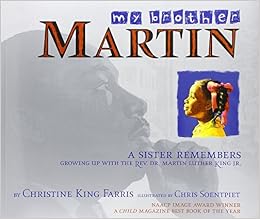
Image result for My Brother MartinThis text was told through the eyes of Christine King Farris the only survivor of king family and sister to Martin Luther King Jr. Christine felt as though it was important for her side of the story to be told, which is why she wrote this text. Throughout the text Christine recalls different events throughout their childhood and everything her brother did to work for change.

Connecting to the Standards 
Grade 2 W (7): Participate in shared research and writing projects (e.g., read a number of books on a single topic to produce a report)

  • Students will meet this standard, because they will work in groups to research facts about Martin Luther King Jr. during a set of particular years in his life. 
Grade 2 SL (2): Recount or describe key ideas or details from a text read aloud or information presented orally or through other media.
  • Students will meet this standard by being able to recall information read from text but will also use other media to find the information they need. 

Learning Outcomes
 Given a particular set of dates, groups of students will work together to come up with 5 important facts about Martin Luther King Jr.'s life, with 80% accuracy.

Adapted to the Classroom
Prior to reading this text you would discuss who Martin Luther King Jr. is and what he he did. While you spend time talking about Martin Luther King Jr. you would set aside to discuss his family members. At this point you would read this text. After reading the students would be divided into groups. Once divided into groups students would use their knowledge of Martin Luther King Jr. and his family to create a timeline of his life. Each group would focus on a certain years, within those years students would have to come with 5 important events. Within each group their will be different roles assigned to each student to make sure all information need is being collected.

Bloom's Taxonomy 
Imagine you were Martin Luther King Jr., would you be able to fight for something you believe in? (Synthesis)
Who is Christine King Farris? (Knowledge)

Differentiation 
For ELL students, they will be given the opportunitiy to work in a group giving them the chance to work with others.
For students who are gifted, they will be required to do extra work on their time period and find more in depth information about Martin Luther King Jr.

And Tango Makes Three

Parnell, Peter and Richardson, Justin. And Tango Makes Three. (2005). Cole, Henry (Illus.). New York, New York: Simon & Schuster

Image result for and three makes tangoIn the Central Park Zoo, there are two male penguins who only dream of having an egg to raise. They try everything they can to get an egg to raise but are no successful. After much waiting they finally got their egg, and were able to be parents. Throughout the text you see the two grow penguins grow into amazing parents.

Connecting to the Standards
Grade 2 W (5): With guidance and support from adults and peers, focus on a topic and strengthen writing as needed by revising and editing.
  • Students will meet this standard when they work on their paragraphs about their family and go through the writing process to get their final product. 
Grade 2 L (2): Demonstrate command of the conventions of standard English capitalization, punctuation, and spelling when writing. A: Capitalize holidays, product names, and geographic names. E: Consult reference materials, including beginning dictionaries, as needed to check and correct spellings.
  • Students will meet this goal when work through writing process. After creating the rough draft they will have to go through and revise, making sure they have spelled unknown workds correctly and that they use proper capitalization in their paper.

Learning Outcomes
Students will create a paper about their family by working through the writing process with 80% accuracy.

Adapted to the Classroom
This would be used in the classroom when discussing the topic of families. When talking about families we would talk about the different traditions each family has and who makes up your family.  After reading this text students would work through the writing process to write a paper on their family. For the final draft students would be allowed to either type their paper on the computer or hand write it if they would like. After they finished writing their paper they would draw a picture of their family to go along with their paper. After students have finished their paper students would be given a chance to stand up in front of the class and read their paper. While the student is reading their paper, their picture of their family would be displayed on the board so that all students could see the visual representation of what the students family look like.

Bloom's Taxonomy 
How many members do you have in your family? (Knowledge) 
Identify one tradition that your family has. (Application)
Elaborate on what your favorite memory is with your family. (Synthesis)

Differentiation 
For students who are ELL, they would be given the option to incorporate some of their native language into their paragraphs and presentation.
For students with Dyslexia they will be allowed to use a dictionary to make sure they are spelling the words correctly.
For students who visual learners they will be given the chance to draw their family members for people to see.

The Book that Jack Wrote

Image result for the book that jack wroteScieszka, Jon. (1994). The Book that Jack Wrote. D. Adel (Illus.). New York, New York: Penguin Books

Using cumulative rhyme, Scieszka takes classic nursery rhymes and creates a poem. The end result is a rather hilarious story with an effective and understandable rhyming scheme.

Connecting to the Standards
Grade 2 RL (4): Describe how words and phrases (e.g., regular beats, alliteration, rhymes, repeated lines) supply rhythm and meaning in a story, poem, or song.

  • This cumulative poem has a lot of rhyme and rhythm in it.
Grade 2 RL (5): Describe the overall structure of a story, including describing how the beginning introduces the story and the ending concludes the action.

  • Not only is this poem cumulative, but it is also circular making it rather unique in this instance.

Grade 2 RL (7): Use information gained from the illustrations and words in a print or digital text to demonstrate understanding of its characters, setting, or plot.

  • The illustrations really illuminate what the story is telling in pretty clear visuals.

Grade 2 SL (1): Participate in collaborative conversations with diverse partners about grade 2 topics and texts with peers and adults in small and larger groups

  • Students will work in small groups to create a visual timeline, sequencing the events in the story.
Adapted to the Classroom
Students will most likely have heard some of the nursery rhymes mentioned in this story like the cow jumping over the moon and Humpty Dumpty. If not, it may be necessary to establish that understanding, and can be done during the course of the reading of the book most likely. It may not be necessary for the teacher to do a read aloud for this one and may be more appropriate for small groups to read together. After all, the vocabulary is not too difficult for 2nd graders. Students should be actively thinking about the sequence of the story and how the beginning and the end relate.

After they have read the story and discussed the sequence, they will create a visual timeline to show that they understand how the story is sequenced. This can be done through visuals for each line; like a pie for the baker and an hat for the hatter. They may draw in the visuals too if you, as the teacher, believe that is something that your classroom can manage effectively. This activity will hopefully help students understand the circular motion of this story. 

Bloom's Taxonomy
Outline the sequence of events. (Analysis)
Create a visual map to go along with the sequence of events. (Synthesis)

Differentiation
There is some more difficult vocabulary in the story, so the teacher should be standing by and observing groups as they read. If a group gets stuck, the student should support the students; possibly guiding them through sounding it out, or asking if they've ever seen that word before. Students who have trouble reading should be put in groups with higher level readers who can support them through their reading.

Henry and Mudge: In the Green Time

Rylant, Cynthia. Henry and Mudge In The Green Time. (1987). Stevenson Sucie (Illus.).
     New York, New York: Bradbury Press

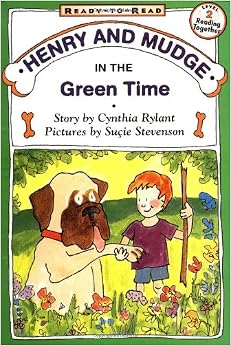
Image result for henry and mudge in the green time summaryThis adventure of Henry and Mudge takes place in the summer and all the things they can do on green grass. They have a picnic on the grass in the park where Henry gets stung by a bee but Mudge cheers him up. They play with the water hose out on the green lawn to give Mudge a bath that he does not like, so he gets Henry back soaking him when he shakes all the water off. Finally Henry and Mudge head up a hill where they let there magic imaginations unleash and eventually get worn out and fall asleep under the tree.

Connecting to the Standards
Grade 2 RL (1): Ask and answer such questions as who, what, where, when, why, and how to demonstrate understanding of key details in text
  • This story allows student to answer a questions about what Henry and Mudge
     do when they are in the 3 different chapter. 
Grade 2 W (3): Write narratives in which they recount a well-elaborated event or short sequence of events, include details to describe actions, thoughts, and feelings, use temporal words to signal event order and provide a sense of closure
  • This story allows students to meet this standard because they can write about the different events in each of the 3 different chapters.

Learning Outcomes
Students will answer the question, "Which Henry and Mudge story was your favorite and why, and who is your favorite character and why?" citing the text twice with 80% accuracy

Adapted to the Classroom 
After reading the text as a class we would discuss what happened in each story. While discussing we would write down a class summary of each text and events we think to be important. It is at this point that I would ask questions to help the children. Through this discussion I would make sure that each students have a good understanding as to what happened in each story. Once student's understanding have been checked, I would then dismiss students to answer the overall question. It is at this time that students would answer the question "Which Henry and Mudge story was your favorite and why?" and "Who is your favorite character and why?"

Once students have completed this text as a class we would then create a graph to see which story was the class favorite and which character was the class favorite.

Bloom's Taxonomy
Who are the main characters in our story? (Knowledge)
 If you were Mudge, how would you solve the problem of not wanted to take a bath? (Application)
Suppose you could have a magical place like Henry and Mudge, what would do when you are at your magical place? (Synthesis)

Differentiation 
For students who are not able to write, we would make sure that they have access to assistive technology that would allow them to type out their answer to the questions.
For students who are gifted we would take the questions one step further to make sure that they are stilling being challenged

Sunday, November 27, 2016

The Three Pigs

Image result for the three pigs david wiesnerWiesner, David. (2001). The Three Pigs. New York, New York: Houghton Mifflin Company.

Taking The Three Pigs to new heights and new places, this unpredictable retelling of the classic story will delight children's imaginations. The three brothers wander from the own story, admittedly leaving the wolf a little baffled, and pick up eccentric characters from different tales. '

Connecting to the Standards
Grade 2 RL (9): Compare and contrast two or more versions of the same story (e.g., Cinderella stories) by different authors or from different cultures.

  • This story provides students with a different version of the familiar story, The Three Little Pigs.

Grade 2 W (3): Write narratives in which they recount a well-elaborated event or short sequence of events, include details to describe actions, thoughts, and feelings, use temporal words to signal event order, and provide a sense of closure.

  • Students will do a creative writing exercise using the same conventions in The Three Pigs, but will have the chance to use the characters in their favorite books to tell the story.

Grade 2 L (2): Demonstrate command of the conventions of standard English capitalization, punctuation, and spelling when writing.

  • Students will write their own narrative and will demonstrate mastery over these conventions through their writing.
Learning Outcomes
From this reading and subsequent activity, students will gain an understanding of comparing and contrasting two similar stories. Over the course of the year, students will continue to read different versions of familiar and similar stories. Students will then use this understanding of differing stories to write a narrative based off a story they are familiar with, using similar storytelling devices to The Three Pigs. Through the writing of this narrative, students will demonstrate their command over writing conventions including "capitalization, punctuation, and spelling..."

The final product, the written narrative, plus any previous rough drafts will be used to show progress towards the standards. Students will have multiple chances to revise and edit their narrative as they work their way through the writing process.

Adapted to the Classroom
Before reading The Three Pigs by David Wiesner, the class will participate in reading other versions of the The Three Little Pigs. Prior to that, it may be a good idea to also introduce other tales and different versions of them to get students used to the idea that storytelling is an art and a story may change based off of who is presenting the story.

Once the book is read, in a teacher-guided read aloud, students will have the chance to discuss the differences in this version of the story to past versions. This discussion will be mostly student-led, but the teacher will most likely need to guide the discussion if it becomes stagnant. Once students have an understanding of the storytelling devices used in The Three Pigs, they will have a chance to go to the library to pick out a book they are familiar with or want to become familiar with. The teacher should also provide more books for students to use who are having trouble deciding what story to use.

Students will then engage in a creative writing exercise that will most likely span over 4-5 days. Students will start with a rough draft of their favorite story, that should follow the devices used in The Three Pigs, such as characters escaping the story, duping the main villain in clever ways, or meeting characters from other stories along the way. Over the course of the next few days, students will have time to revise and edit their stories until they are left with a final draft that they submit. It would be fun for the teacher to put these stories into a classroom collection, either in book form or online for parents to view. 

Bloom's Taxonomy
Who are the main characters in your narrative? (Knowledge)
What differences exist between the original story and this retelling? (Comprehension)
How would you create a new ending for your story? (Synthesis)
What might happen if you combined this story with this other one? (Synthesis)

Differentiation
Because this project involves a lot of reading and writing, the main concern would be with students with disabilities that affect their ability to read and write such as students with dyslexia. Additional support should be provided to these students and possibly include one-on-one sessions with these students to check their progress. Additional supports could be put in place to make sure they succeed such as having a dictionary nearby for students to refer to (this could be done for any student) or having technology that is meant to support students with dyslexia or other language disorders.

Saturday, November 26, 2016

John, Paul, George, & Ben

Image result for john paul george and ben by lane smithSmith, Lane. (2006). John, Paul, George & Ben. New York, New York: Hyperion Books.

Laced with historical humor, this book is a (mostly) accurate telling of the events leading to the American Revolution and the men involved. It shows how the five men, John Hancock, Paul Revere, George Washington, Ben Franklin, and Thomas Jefferson, acted when they were children and how that behavior led to their bravery and ingenuity as adults.

Connecting to the Standards
Grade 2 RL (1): Ask and answer such questions as who, what, where, when, why, and how to demonstrate understanding of key details in a text

  • .The books main characters are familiar historical figures and the book does a good job of differentiating each character and what part they play in the story. Students will be able to recognize at least who they are, what they did, when they lived, and how they effected the outcome of the story.

Grade 3 RL (3): Describe characters in a story (e.g., their traits, motivations, or feelings) and explain how their actions contribute to the sequence of events.

  • Through a little more research, students will be able to understand and describe each character including their behaviors and their individual personalities. They will also be able to explain the effect they cause through their actions.

Grade 2 W (7): Participate in shared research and writing projects (e.g., read a number of books on a single topic to produce a report; record science observations).

  • Students will participate in a group project exploring one of the five characters in the books in more detail. 

Grade 3 W (7): Conduct short research projects that build knowledge about a topic.

  • Students will participate in a group project that researches in detail the lives of one of the five characters from the book.

Grade 2 SL (1): Participate in collaborative conversations with diverse partners about grade 2 topics and texts with peers and adults in small and larger groups.

  • Students will discuss, in small groups, the cause-and-effect shown in this story, the characters of the story, and how it connects to previous discussions on the American Revolution.

Grade 2 SL (2): Recount or describe key ideas or details from a text read aloud or information presented orally or through other media.

  • Students will present their findings from their research project to the classroom in a group effort.
Learning Outcomes
By the end of this lesson, students will have, at least, a basic understanding of cause-and-effect and will be able to explain how cause leads to effect. Students will be able to set out to research any topic using various resources. Students will be able to effectively collaborate with group partners to implement and execute a research plan. Students will be able to present their research findings clearly and effectively to the classroom.

Adapted to the Classroom
First off, it is important to establish some background knowledge on the American Revolution and, in particular, the five people mentioned in the book. Students will watch informational videos, read about the war, and talk about what they know about the American Revolution.

Once students are familiar with the Revolution, I would read the book in a teacher-guided read-aloud. Students should be able to make connections to what they know to what they hear during the reading. They will be encouraged to raise their hands and ask questions or make comments (within the boundaries of the rules).

Students will then engage in a project with small groups of 5 or 6 to research one of the individuals from the story. They will learn to work as a team by doing group research and assembling a presentation together. Students will use a variety of resources to research including internet, informational texts, historical accounts, etc. Finally, students will present the information they've accumulated to the class.

Bloom's Taxonomy
Who, what, when, where, and how. (Knowledge)
Why is _______ significant? (Application)
Outline (Analysis)
What is most important? (Evaluation)

Differentiation
Because this lesson does have a lot of research involved, a lot of support should come from the teacher. This may be one of the first time students engage in a large amount of research and may not know exactly where to look, giving the teacher an opportunity to establish a scaffold. Once students have enough knowledge on research, the scaffold can be slowly removed. SPED students can still participate in this project and should be paired with traditional students who can give them some additional support.